


Marketing
AI crawlers read your store but rarely send clicks: what to do about it

Mariángeles Leiva Luque
Published · 7 min
The short answer
AI bots read your store far more often than they send you visitors. According to Cloudflare Radar data published by Seomator, in October 2026 OpenAI made 775 page requests for every visit it referred, and Anthropic made 482. On top of that, since late September many ChatGPT clicks arrive without a referrer, so GA4 lumps them in with direct traffic.
That does not mean AI fails to sell. In a Shero Commerce study of 96 million sessions across 73 stores, AI assistants drove only 0.21% of visits, yet that traffic converted 25% better than Google organic. For an ecommerce store the job has three parts: measure what you can (an AI channel in GA4 plus a "how did you hear about us?" question), let search bots in, and prepare product pages so an AI can quote them (what is now called GEO, or generative engine optimization).
What I saw at Growth Lab: 481 reads in one day
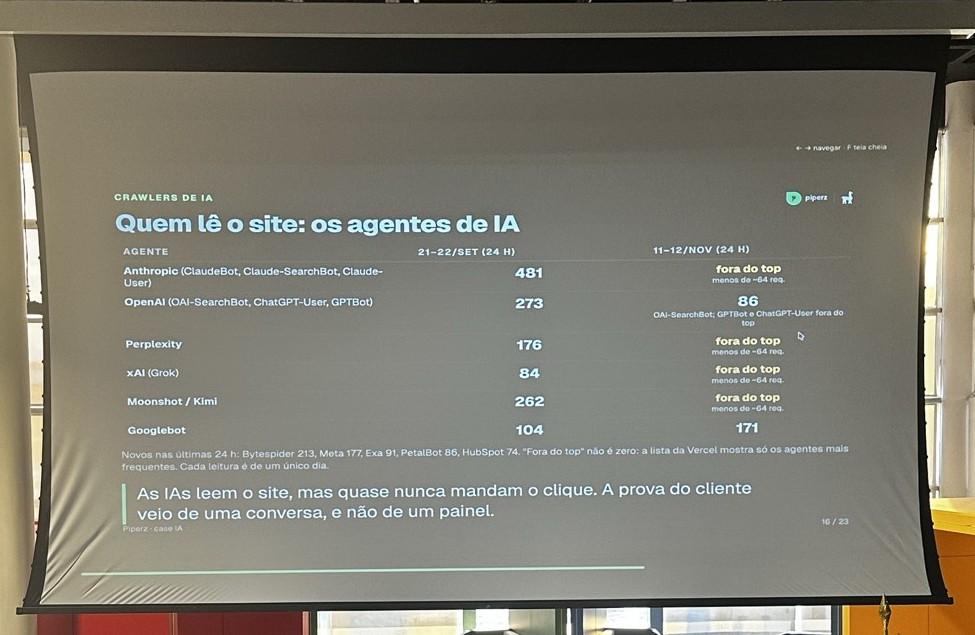
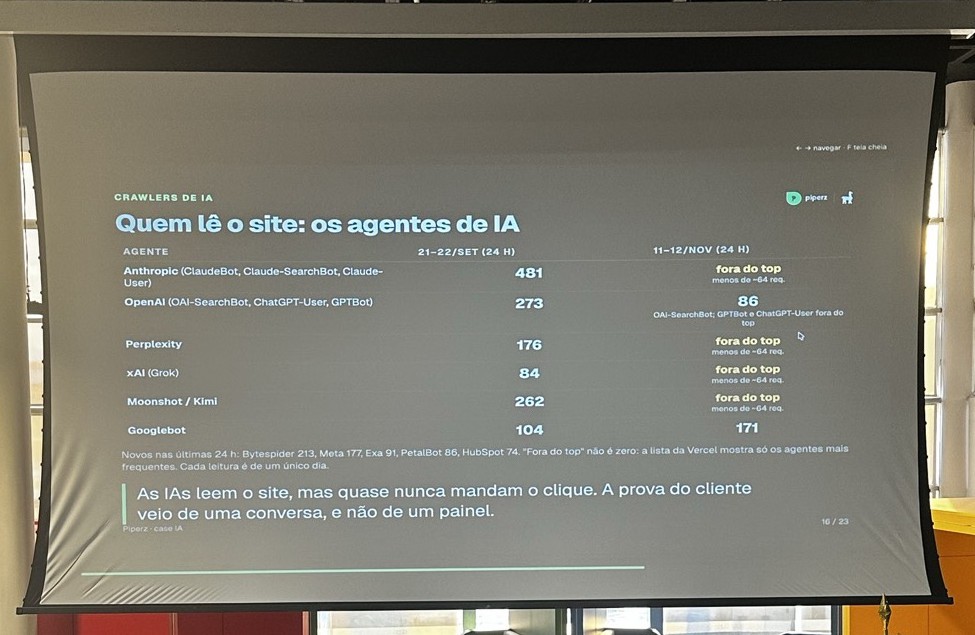
On November 12, at Growth Lab in Florianópolis, Brazil, Michell Lech (Piperz and Alpaca Labs) showed how many times AI agents read a client's site in 24 hours. I mentioned it in my event recap, but the numbers deserve their own post.
| Agent | Sept 21 to 22 (24 h) | Nov 11 to 12 (24 h) |
|---|---|---|
| Anthropic (ClaudeBot, Claude-SearchBot, Claude-User) | 481 | Outside the top list (under 64) |
| OpenAI (OAI-SearchBot, ChatGPT-User, GPTBot) | 273 | 86 |
| Moonshot / Kimi | 262 | Outside the top list |
| Perplexity | 176 | Outside the top list |
| xAI (Grok) | 84 | Outside the top list |
| Googlebot | 104 | 171 |
Source: Piperz slide, Growth Lab, Nov 12, 2026. "Outside the top list" does not mean zero: the Vercel dashboard only lists the most frequent agents.
The line that closed the slide stuck with me: "AI reads the site but almost never sends the click. The client's proof came from a conversation, not a dashboard."
Why they read so much and send so little
Not every AI bot does the same job. It helps to split them into three groups, because whether you let them in depends on the group:
| Bot type | Examples | Why it reads your store |
|---|---|---|
| Training | GPTBot, ClaudeBot | Collects text to train models. Sends no direct visits. |
| Search | OAI-SearchBot, Claude-SearchBot, PerplexityBot | Builds the index the AI checks when someone asks a question. This is the one that can get you into an answer. |
| User request | ChatGPT-User, Claude-User, Perplexity-User | Visits on the spot because a person asked the AI to look at that page. |
Each company documents what its bots do: see OpenAI's bot documentation, Anthropic's crawler page and Perplexity's crawler docs.
The AI reads your product page, summarizes the answer in the chat, and the person often has no reason to click through. That is why reads and visits are so unbalanced. Cloudflare Radar figures (pulled by Seomator on Oct 31, 2026) show how many pages each platform reads per visit it sends:
| Platform | September 2026 | October 2026 |
|---|---|---|
| Perplexity | 2,373 reads per visit | 4,056 |
| OpenAI | 341 | 775 |
| Anthropic | 549 | 482 |
| Microsoft (Copilot) | not published | 40 |
| not published | 4.8 |
OpenAI's jump from September to October has a technical cause: ChatGPT links stopped passing the referrer. On Seomator's own site, ChatGPT visits kept coming and grew 48%, but the share tagged as chatgpt.com fell from about half to almost nothing.
Few visits, but the buying kind
Here is the part that matters for a store. Shero Commerce analyzed 96.4 million sessions from 73 ecommerce sites between September 2025 and September 2026:
- AI assistants drove 0.21% of sessions and 0.26% of orders.
- Over the year, visits stayed almost flat while orders nearly tripled.
- AI conversion rate was 1.32%, against 1.09% for Google organic at the median store.
- ChatGPT accounted for 88.1% of all AI visits.
- 51% of AI visits landed directly on product pages, which converted at 1.77%. The homepage converted at 0.57%.
The same study notes that GA4 undercounts: taps from mobile apps and purchases made by an agent are not always recorded as AI. After ChatGPT's September change, that gap got wider.
So AI traffic is small, but it arrives ready to buy. And what you see in GA4 is less than what is really happening.
How to measure it in your store
1. Create an "AI" channel in GA4
By default GA4 files these visits under "Referral" or "Direct". Build a custom channel group (Admin > Channel groups) with an "AI" channel that captures sessions whose source matches this expression:
chatgpt\.com|openai\.com|perplexity\.ai|claude\.ai|gemini\.google\.com|copilot\.microsoft\.comPlace it above "Referral" so it takes priority. Many ChatGPT links carry utm_source=chatgpt.com, so GA4 can still recognize those visits without a referrer. If you get lost among dimensions and metrics, use our GA4 reference of dimensions, metrics and events.
2. Ask "how did you hear about us?"
That is what the Piperz case confirmed: the proof came in a conversation. Add the question at checkout, on your contact form or in the first WhatsApp message, with a "ChatGPT or another AI" option. It is the only way to see what web analytics misses.
3. Check bots in your server logs
If your store runs on Vercel, Cloudflare or your own server, you can see which bots visit and which pages they read. On platforms like Shopify or Tiendanube, store owners do not always get that data. In that case, steps 1 and 2 are enough.
How to get AI to quote you
Let search bots in
Check your robots.txt file. You may choose not to share content for training (GPTBot, ClaudeBot), but if you block OAI-SearchBot, Claude-SearchBot or PerplexityBot, you will not show up when someone asks an AI what to buy. If you are not sure what your robots.txt says, ask whoever manages your platform.
Build product pages that answer on their own
If half of AI visits land on product pages, that is the page to work on. An AI quotes what it can read as text:
- Price and installment options visible in the text, not only in a banner.
- Size, materials and who the product is for.
- Shipping cost and delivery time by region.
- Return policy on the page or one click away.
- Real FAQs, taken from WhatsApp chats and reviews.
In the case Piperz presented, a single page answering something people search for earned 27% of appearances and 65% of citations. Structured data helped as a baseline, but did not explain the result on its own. The steps for your own site are in how to show up in ChatGPT and AI answers and our ecommerce SEO guide.
Do not expect miracles from llms.txt
llms.txt is a proposed file that gives AI tools a summary of your site. It is cheap to make and we already have one at We make it Lab, but there is no public evidence yet that major platforms use it to decide what to quote. Do it if you have half an hour to spare. Product pages come first.
What to avoid
- Judging AI by its GA4 channel. You will see less than what happens, especially since late September 2026.
- Blocking every AI bot at once. You cut training, but you also cut the search that could recommend you.
- Stuffing product pages with text for AI. Write for the shopper. If the answer is clear to a person, it is clear to an AI.
- Moving ad budget because of this. At 0.21% of sessions, AI currently complements Meta and Google. It does not replace them. Ads inside ChatGPT are a different, paid channel: we cover them in how to advertise on ChatGPT.
Conclusion
AI tools already read your store every day. What they do not do yet is send many visitors, and the few they send are getting harder to see in analytics. The practical answer is to measure with two sources (GA4 and asking customers) and to work on product page SEO, which are the pages AI quotes and where those visitors buy.
If you want to know how much AI traffic is already reaching your store and which product pages to fix first, book a 30-minute account diagnosis with us. In the meantime, see our client cases.
Sources
- Michell Lech's talk (Piperz / Alpaca Labs) at Growth Lab 3rd edition, Florianópolis, Nov 12, 2026. Figures from the slide "Quem lê o site: os agentes de IA".
- GEO Data Report, October 2026: crawl-to-refer ratios, Seomator, using Cloudflare Radar data pulled on Oct 31, 2026.
- What 96 Million Sessions Show About AI Referral Traffic and Conversions, Shero Commerce, published Sept 28, 2026 (data from Sept 1, 2025 to Sept 26, 2026).
You might also like
Growth Lab Florianópolis: 7 lessons on AI and pipeline 2027 from a founder's notebookFrequently asked questions
- Does ChatGPT send traffic to online stores? Yes, but not much. In a study of 73 stores, AI assistants drove 0.21% of sessions, and ChatGPT was 88% of that traffic. Those visits converted 25% better than Google organic.
- How do I see ChatGPT traffic in Google Analytics 4? Create a custom channel group with an "AI" channel that groups sources like chatgpt.com, perplexity.ai, claude.ai and gemini.google.com. You will still see less than the real number, because since late September 2026 many ChatGPT clicks arrive without a referrer and count as direct.
- Should I block GPTBot and ClaudeBot in robots.txt? It depends on whether you want your content used to train models. What matters is not blocking search bots (OAI-SearchBot, Claude-SearchBot, PerplexityBot), because they are what lets an AI recommend you.
- Which page of my store is most likely to appear in an AI answer? The product page. In the Shero Commerce study, 51% of AI visits landed on product pages, which converted at 1.77% against 0.57% for the homepage.
- Does llms.txt help me show up in ChatGPT? It is easy to create, but there is no public evidence yet that major platforms use it to choose what to quote. Complete, clear product pages pay off more.
About the author

Mariángeles Leiva Luque
Marketing & Comms · We make it Lab
Explore more on