


Marketing
An AI agent team for marketing: the writer never approves

Mariángeles Leiva Luque
Published · 9 min

The short answer
AI agents for marketing work best as a team where each agent has a single role and nobody checks their own work: one agent writes, a different agent reviews against a fixed checklist, and a person approves whatever goes out to the client or the store. The rule has evidence behind it: a 2024 study by Panickssery, Bowman and Feng published on arXiv found that language models tend to score their own texts higher than others' texts, even when human raters consider them equal in quality.
Anthropic, OpenAI and Google describe the same setup in their official guidance for building agents: a generator, a separate evaluator and human checkpoints for sensitive decisions. Here is how we apply it at our agency, so you can copy it for your online store.
Where the idea comes from: the Piperz agent team
On November 12, I went to Growth Lab 3ª edição in Florianópolis, Brazil (I covered it in full in 7 lessons I brought back from Growth Lab). Michell Lech, CMO of Piperz and founder of Alpaca Labs, showed how they produce content with a team of agents.
Each agent has one role and works in a separate session: one researches, one builds the editorial plan, one writes, one does an independent review and one releases the post. All of them read the rules from a single document they call the editorial constitution. After several rounds of switching tools, these were the four principles that stuck:
The writer never approves.
One single source of rules instead of scattered instructions.
A number only goes in with a source and a date range.
The agent proposes; the decision to publish follows a rule and a review.
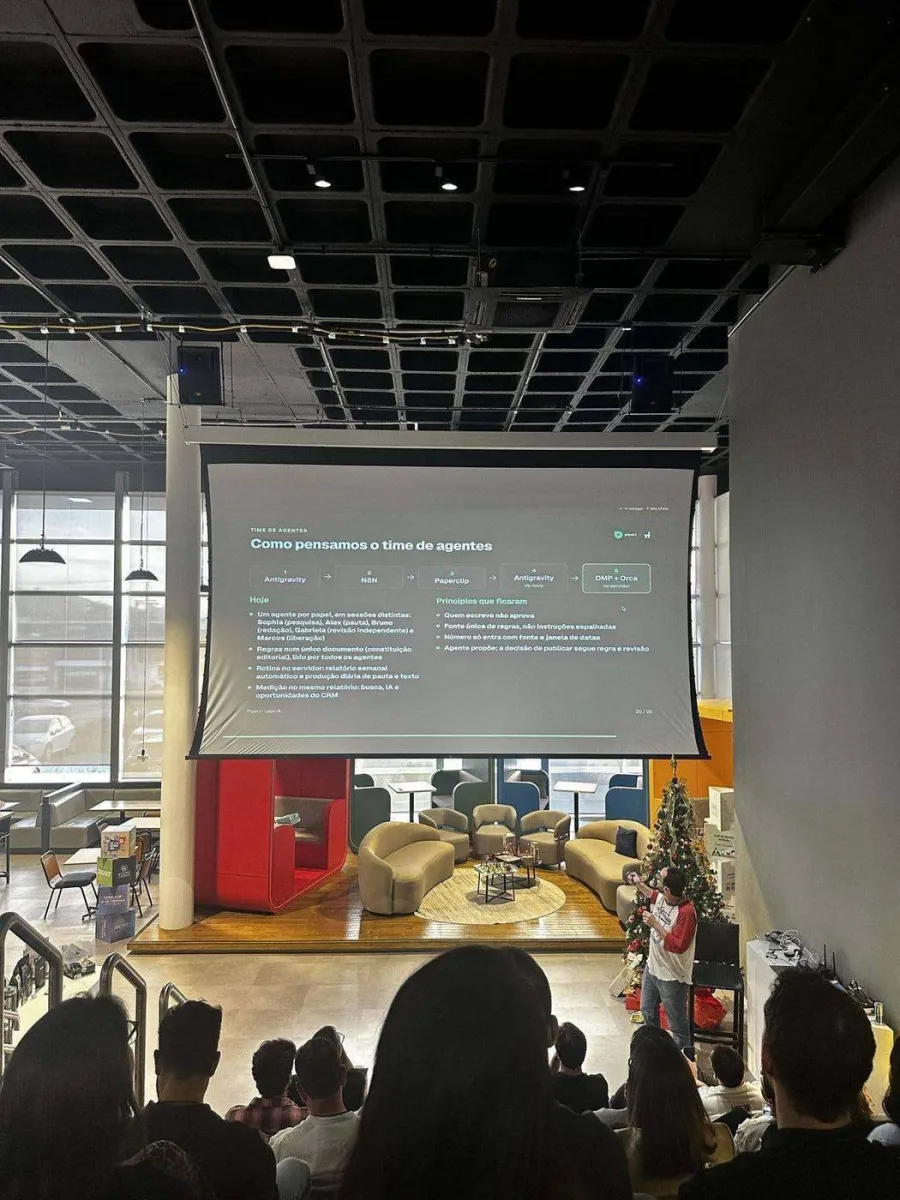
For your store: before adding tools, write down who does each task and who checks it. If the same person (or the same agent) does both, that is your first risk.
Why the writer cannot be the approver
Three studies with clear methodology explain it.
The first is the self-preference study I mentioned above. The authors tested models such as GPT-4 and Llama 2 as evaluators and found a self-preference bias: the model scores its own writing higher. They also found that the better a model recognizes itself, the stronger the bias.
The second was presented at ICLR 2024 under a direct title: Large Language Models Cannot Self-Correct Reasoning Yet. The conclusion is that, without external feedback, models struggle to correct their answers and sometimes get worse after trying.
The third looked at why systems with several agents fail. The authors of the MAST taxonomy of multi-agent system failures (Cemri et al., 2025) collected more than 1,600 annotated traces across 7 popular frameworks and defined 14 failure modes. One of their three categories is task verification. They also note that, on popular benchmarks, the gains from using several agents are often minimal: adding agents without design guarantees nothing.
| Study | What it measured | What it means for your team |
|---|---|---|
| Panickssery et al., 2024 | Whether a model prefers its own texts | The reviewer must be another agent and, ideally, another model |
| Huang et al., ICLR 2024 | Whether a model can fix itself without outside help | Reviews need external criteria (a checklist, a source) |
| Cemri et al., 2025 (MAST) | Why multi-agent systems fail | Verification is its own step, with an owner |
What to do: stop asking the same chat to "review what you wrote." Open a new session and give it only the text and the checklist.
What Anthropic, OpenAI and Google recommend
All three companies agree on the design, each with its own name for the pattern.
Anthropic, in its engineering guide on building effective agents (December 2024), describes the evaluator-optimizer pattern: one model generates a response while another evaluates it and gives feedback in a loop. It notes the pattern works best when there are clear evaluation criteria. It also recommends starting with the simplest possible solution and adding complexity only when needed.
OpenAI, in its practical guide to building agents, released in April 2025, asks teams to plan for human intervention in two cases: when an agent exceeds a retry limit and when an action is sensitive, irreversible or high stakes (its examples are canceling orders, authorizing large refunds or making payments). Its general advice is to get the most out of a single agent before splitting work across several.
Google, in its Agent Development Kit documentation on multi-agent workflow patterns, lists the generate and review pattern (a generator agent and a critic agent), iterative refinement with a maximum number of rounds, and the human-in-the-loop pattern for oversight, approval or correction.
| Company | Pattern name | What it recommends |
|---|---|---|
| Anthropic | Evaluator-optimizer | One model generates, another evaluates with clear criteria |
| OpenAI | Human intervention | A person is required for irreversible or high-stakes actions |
| Generate and review, human in the loop | A separate critic agent and a cap on iterations |
What to do: before you build anything, write down your evaluation criteria. If you cannot write what is right and what is wrong, the reviewer agent will not be able to decide either.
How we work at We make it Lab
At the agency we apply the same three-step rule to the deliverables that go through AI: blog posts, ad copy, reports and social media pieces.
One agent writes. It follows a written manual (our version of the editorial constitution) covering tone, allowed sources, what we never say and format. That manual lives in Claude skills, so it does not depend on someone remembering to paste the instructions.
A different agent does quality control. It runs in a separate session, without the writer's history. In Claude Code this is handled with subagents, which according to Anthropic's documentation run in their own context window with independent permissions. The reviewer checks against a list: whether it meets the brief, spelling, whether every number has a source, whether links work and whether there are typical traces of AI writing. It gets two rounds at most. If errors remain after that, the deliverable is flagged for review and does not move forward.
A person approves what goes to the client. Our account manager or I review the result before sending it. The same goes for ad accounts: an agent can read data from Meta or Google (we explain how we connect them in how to connect Claude to your CRM or ERP with MCP), but raising a budget or pausing a campaign is a human decision.
This article went through that same loop before it reached the blog.
What to do: if your team already uses AI, add one single step: a separate reviewer with a ten-point checklist. At the agency it was the simplest change to put in place.
How to build your agent team in 5 steps
For an online store, the full team has four roles:
| Role | What it does | What it cannot do | Store example |
|---|---|---|---|
| Researcher | Gathers sourced data | Write the final text | Reviews FAQs and customer reviews |
| Writer | Writes following the manual | Approve its own text | Drafts the product page or the email |
| Reviewer | Checks against the list | Rewrite the style to taste | Verifies price, installments, shipping and spelling |
| Human approver | Decides what goes out | Delegate anything irreversible | Publishes the page or launches the campaign |
Pick one repeatable task. Product pages, ad copy or post-purchase emails. Start with just one: both Anthropic and OpenAI recommend starting simple.
Write the constitution. One document with tone, banned claims, where prices and installment terms come from, and which data needs a source. We explain it in how to implement Claude in a company.
Separate writer and reviewer. Different sessions, and the reviewer only receives the text and the checklist.
Define what a person always approves. Everything that reaches the end customer, prices and any budget change in your store's paid media.
Cap the rounds and track the cost. In its article on its multi-agent research system (June 2025), Anthropic reported that the system outperformed a single agent by 90.2% on its internal evaluation, but that multi-agent systems use about 15 times more tokens than a chat.
What to do: start with a writer and a reviewer. Add a researcher and an orchestrator only if volume calls for it.
What to avoid
Instructions scattered across ten prompts. When a rule changes, nobody knows where to update it. Keep one source.
Letting an agent publish or touch budgets without a person. Moving money is exactly the kind of action OpenAI flags as high risk.
Starting with six agents. More agents add cost and failure points, as the MAST study shows.
Numbers without a source. If the reviewer cannot open the source and confirm the figure, the figure stays out.
Conclusion
An AI agent team for marketing pays off when roles are separated: one agent produces, another checks against written criteria and a person decides anything that moves money or reaches the client. It is the rule Piperz showed at Growth Lab and the one in the documentation from Anthropic, OpenAI and Google.
If you want to bring this setup to your team, we offer Claude Code training for teams and build custom automations. And if you run an online store and want to know where your ad budget is leaking, book a 30-minute account diagnosis with us.
Sources
LLM Evaluators Recognize and Favor Their Own Generations, Panickssery, Bowman and Feng, arXiv, April 2024 (accessed 15-nov-2026).
Large Language Models Cannot Self-Correct Reasoning Yet, Huang et al., ICLR 2024 (accessed 15-nov-2026).
Why Do Multi-Agent LLM Systems Fail?, Cemri et al., arXiv, March 2025, revised October 2025 (accessed 15-nov-2026).
Building effective agents, Anthropic, 19-dec-2024 (accessed 15-nov-2026).
How we built our multi-agent research system, Anthropic, 13-jun-2025 (accessed 15-nov-2026).
Create custom subagents, Claude Code documentation, Anthropic (accessed 15-nov-2026).
A practical guide to building agents, OpenAI, released 17-apr-2025 according to Maginative coverage; the PDF itself is undated (accessed 15-nov-2026).
Workflow patterns, Agent Development Kit, Google (accessed 15-nov-2026).
Presentation by Michell Lech (Piperz / Alpaca Labs) at Growth Lab 3ª edição, Florianópolis, 12-nov-2026. Data taken from the slide.
You might also like
Claude as an operations hub: how we connect ads, CRM and reportingFrequently asked questions
- What is an AI agent team for marketing? A group of AI agents, each with one role (research, write, review, release), working from the same written rules. A person approves what goes out.
- Why isn't it enough to ask the AI to review its own text? Because models tend to prefer their own texts and struggle to self-correct without external feedback, according to 2024 studies published on arXiv and presented at ICLR.
- Do I need different models for writing and reviewing? It is not required, but it helps: self-preference bias shows up when a model evaluates its own texts. At a minimum, the reviewer works in a separate session, without the writer's history, and with a written checklist.
- Which decisions should always be made by a person? Irreversible or high-stakes ones: publishing, changing prices, moving ad budget, answering a customer complaint. That is what OpenAI's guide proposes.
- How much does an agent team cost? It depends on volume. As a reference, Anthropic reported that its multi-agent systems use about 15 times more tokens than a chat, so start with two agents and measure.
About the author

Mariángeles Leiva Luque
Marketing & Comms · We make it Lab
Explore more on